
BMW F36 420d (B47 Engine): DPF Exhaust Gas Differential Pressure
Disclaimer:
This post is based on my personal experience and intended for informational and educational purposes only. Procedures, tools, and parts may vary depending on the vehicle and situation. Always consult your service manual or a professional before performing any maintenance.For more information, please read the full disclaimer here.
DPF Exhaust Gas Differential Pressure
In modern diesel engines, the Diesel Particulate Filter (DPF) plays a crucial role in reducing particulate emissions. One of the key metrics for monitoring the health of the DPF is the Exhaust Gas Differential Pressure, measured in hectopascals (hPa).
This differential pressure represents the difference in exhaust gas pressure before and after the DPF filter. As the filter accumulates soot (particulate matter), the resistance increases, leading to a rise in differential pressure.
How Does DPF Exhaust Gas Differential Pressure Work?
Notice: This section was generated with the help of AI 🙂
BMW F36 420d with the B47 engine (140kW) uses sensors to measure the exhaust pressure upstream and downstream of the DPF. These values allow the ECU to determine how much soot has accumulated. When a threshold is reached, the system performs passive or active regeneration, during which the soot is burned off, restoring the filter’s flow capacity.
DPF pressure depends on several factors:
- Amount of soot in the filter
- Engine speed (RPM)
- Engine load
- Exhaust gas temperature
Why Is It Important?
Monitoring the differential pressure helps:
- Detect DPF issues early, before warning lights appear
- Prevent costly DPF replacements
- Maintain engine performance and fuel economy
- Avoid excessive turbo and engine wear
📊 DPF Differential Pressure Values — BMW 420d (B47 Engine)
Monitoring exhaust gas differential pressure is crucial for assessing the health of your DPF system. Below are the typical pressure ranges based on engine RPM and load for the BMW F36 420d with B47 engine (140 kW).
| Engine Mode | Expected DPF Pressure | Comments |
|---|---|---|
| Idle (~900 RPM) | 3 – 10 hPa | Indicates clean or mildly loaded DPF |
| Light throttle (1500–2500 RPM) | 10 – 30 hPa | Typical for city or normal highway driving |
| Under load (hills, acceleration) | 30 – 70+ hPa | Higher pressure due to exhaust flow |
| Critical / Clogged | 100+ hPa | ⚠️ Potential DPF blockage or regen failure |
These reference values can help you better understand how your DPF system is performing and when preventive maintenance might be required.
My Vehicle Measurements at 112,369 km
Vehicle: BMW F36 420d, B47 Engine (140kW)
Tool Used: OBD diagnostic scanner
Observations at ~ 900 RPM
- DPF Soot Mass: 22.87 g
- DPF Exhaust Gas Differential Pressure: 6 hPa
- Oil Change Since: 7737 km
- Air Mass Flow: 27 kg/h
- Oil Pressure: 1372 hPa
Interpretation:
- The 6 hPa pressure at idle indicates a healthy and clean DPF.
- A soot mass of 22.87 g suggests that the filter is mid-way through its load cycle—approaching the regeneration threshold but not yet critical.
- Air and oil measurements are within expected ranges.
Observations at ~1500 RPM
At around 1500 RPM, the differential pressure naturally increases as more exhaust gases pass through the DPF system. Here’s what I recorded during my analysis:
📊 Engine at ~1500 RPM:
- DPF Exhaust Gas Differential Pressure: 15 hPa
- Air Mass Flow: 52 kg/h
- Oil Pressure: 1665 hPa
- Oil Change Since: 7737 km
These values indicate a system that is operating efficiently and within expected thresholds.
Interpretation
✅ DPF pressure of 15 hPa at 1500 RPM is well within normal range (10–30 hPa), showing no excessive backpressure
✅ Air mass flow of 52 kg/h confirms proper combustion air intake
✅ Oil pressure is elevated appropriately with RPM, reflecting healthy lubrication system behavior
✅ The pressure increase from 6 hPa (idle) to 15 hPa (1500 RPM) is proportional, which strongly suggests:
- Good DPF flow characteristics
- No early signs of clogging
- Proper functioning of the pressure sensor and exhaust flow system
Visualization
Notice: This section was generated with the help of AI 🙂
Here is a graph showing the typical trend of DPF pressure as RPM increases on a healthy DPF system:
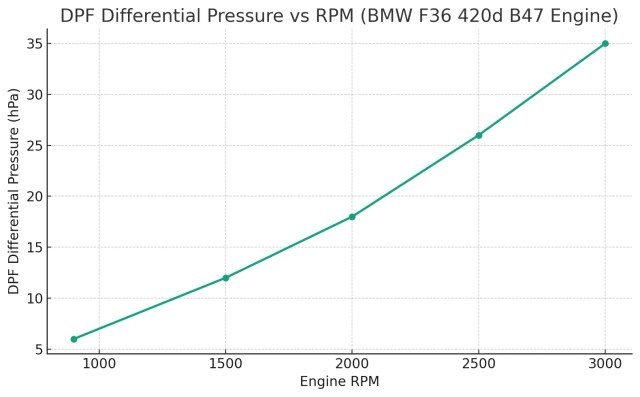
⚠️ Note: These are typical values for a clean or mildly loaded DPF. Significantly higher pressures at lower RPMs may indicate problems such as:
- DPF clogging
- Sensor failure
- Leaks or exhaust restrictions
Conclusion
Regularly checking the DPF Exhaust Gas Differential Pressure provides valuable insight into the condition of your exhaust system. At 112,369 km, my BMW F36 420d (B47 engine) shows excellent DPF health, with:
- Low idle pressure
- Reasonable soot mass
- Normal system response at higher RPMs
I recommend occasional monitoring for all diesel car owners. This simple check can extend the life of your DPF, optimize engine performance, and prevent costly repairs.
Regeneration Log – Real Data from My BMW 420d
To better understand how DPF pressure and soot values relate to actual regenerations, I’ve also documented all regeneration events performed by my car so far.
📘 You can view the complete regeneration history here:
👉 BMW F36 B47 DPF Regeneration Log – Live Data Analysis
This log includes:
- Total number of DPF regenerations
- Distance between regenerations
- Soot load
- Time since oil change
- Conditions that trigger regeneration
🔍 If you’re trying to understand when and why DPF regenerations happen — or how driving style and oil age affect soot production — this data can help you connect real-world pressure values with actual DPF cleaning cycles.
About the Author


